The Third Strap guide
A well-fitting harness starts with a few careful measurements. You need a soft measuring tape, a quiet moment and your dog standing naturally. Choose your model below: the chest measuring point and strap lengths differ between designs.
Measure on level ground with all four paws down. Do not lift their head or stretch their body into position. If they move around, ask someone to help and take a short break.
Lay it flat against the body without twisting it or compressing the skin. Record the actual measurement rather than adding a few extra centimeters. Use the chart and a fitting check to assess the room needed.
Repeat each measurement. Write down the result in centimeters with the strap name and harness model. Measure your dog, rather than an old harness laid flat on a table.
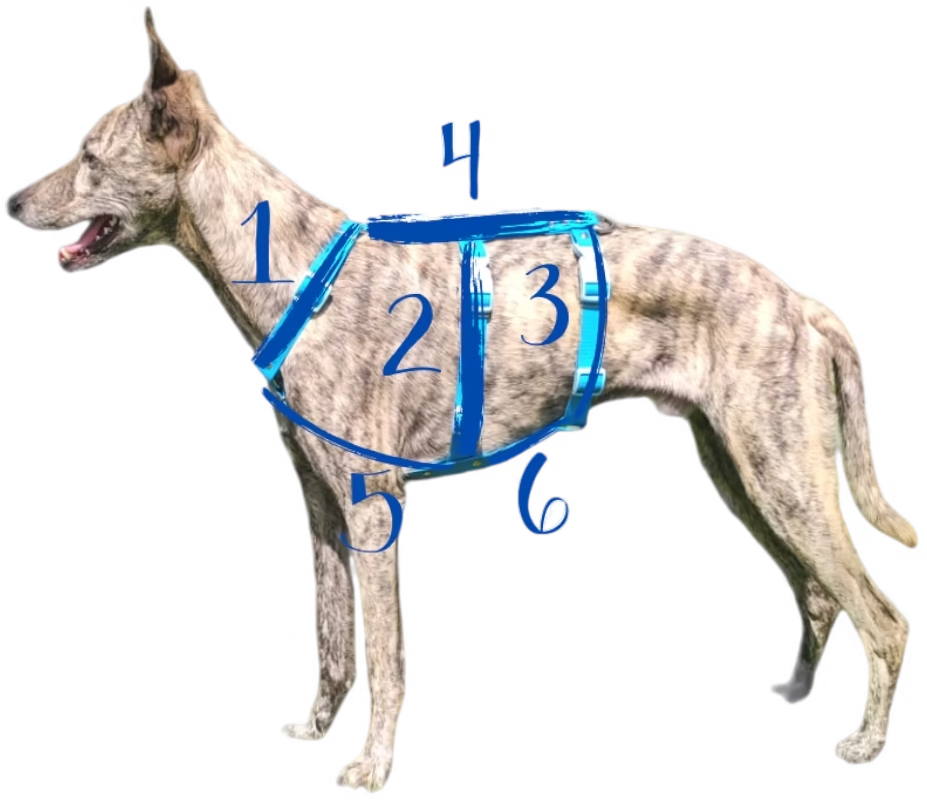
Compare every measurement with the adjustment ranges in the chart. If your dog falls between two sizes, choose the larger one. Also check that its minimum circumferences and strap lengths still fit your dog.
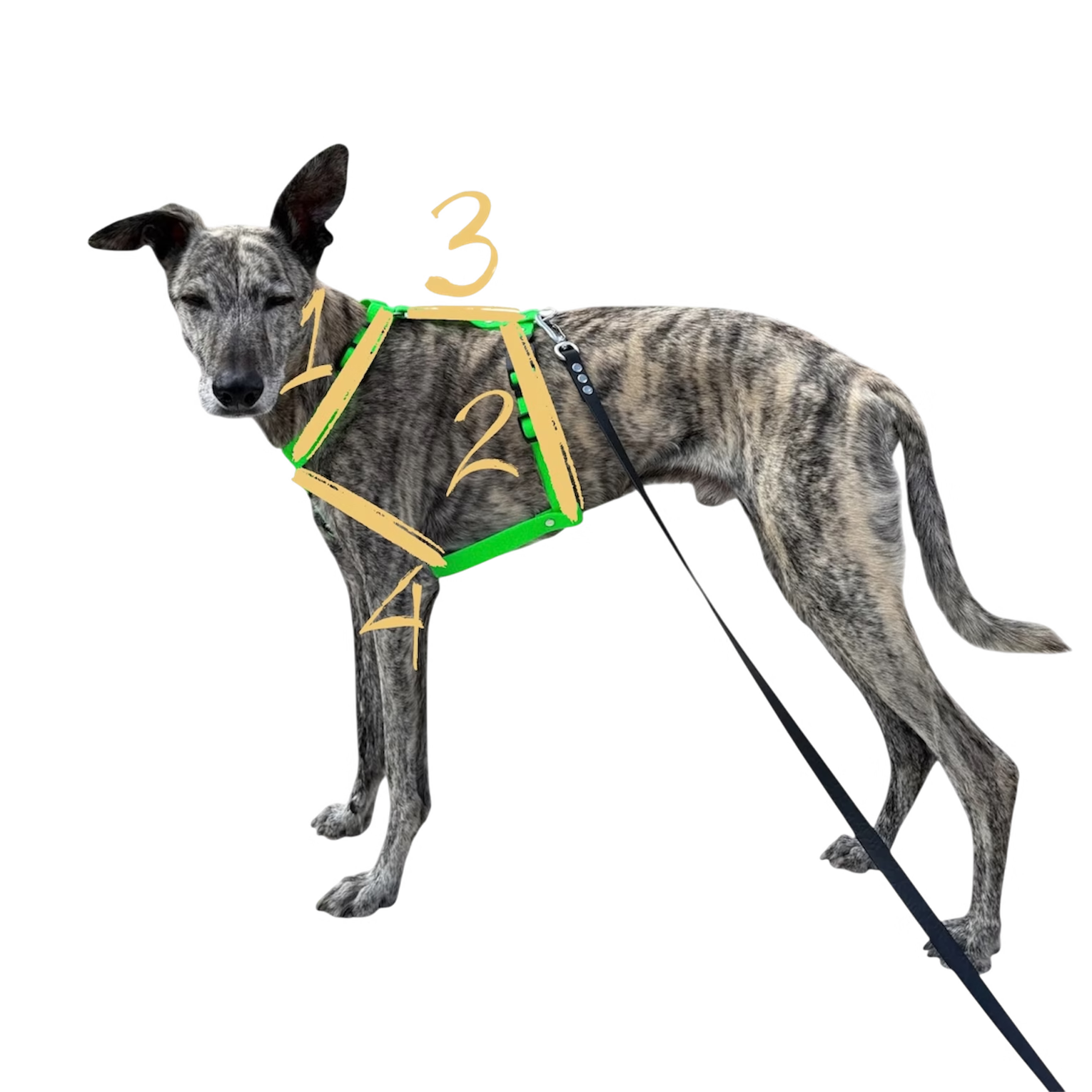
Pay particular attention to the chest measuring point: it is different from the one used for the Y-harness. If you are unsure after purchase, send us your dog's breed and measurements and we will check the fit.
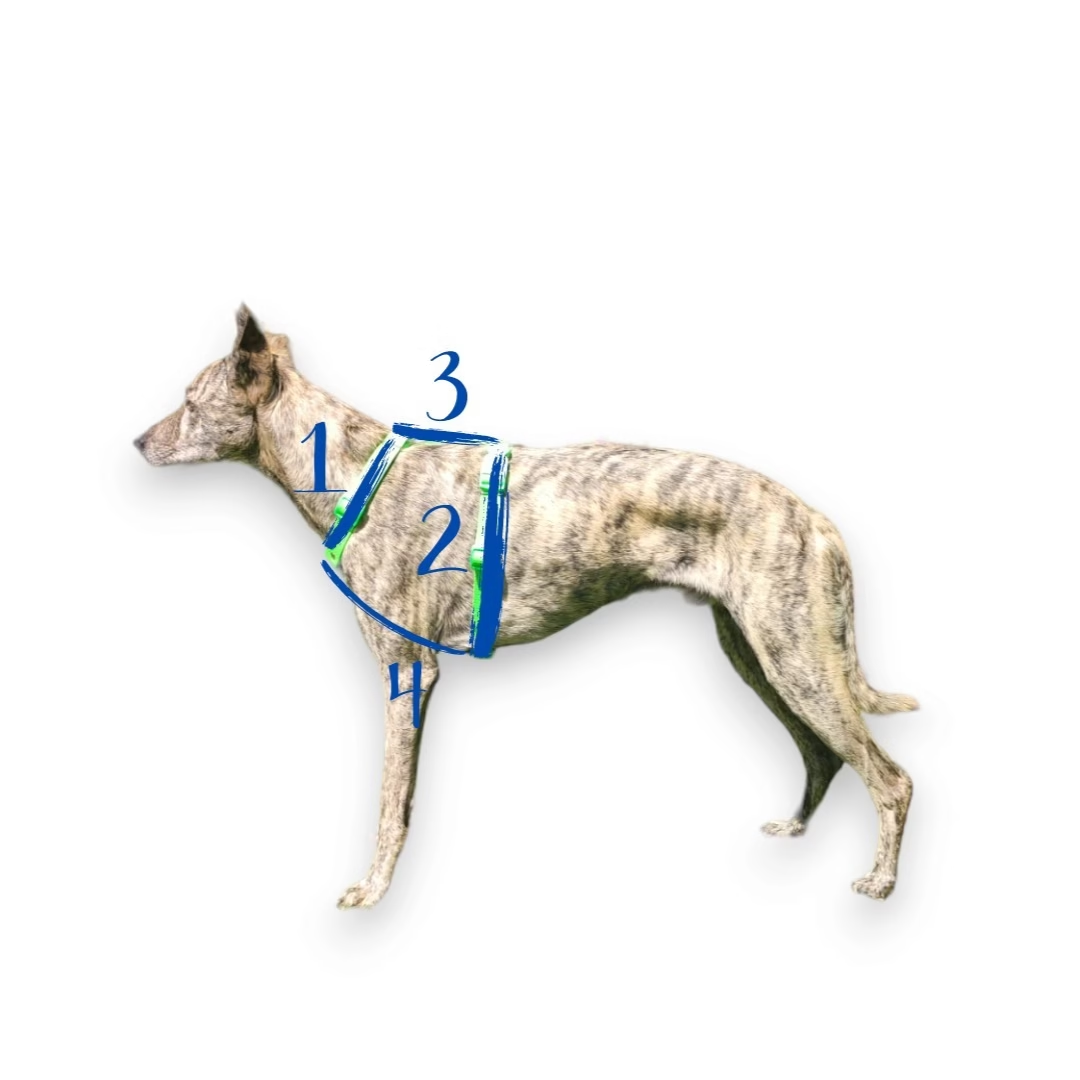
Compare every measurement with the adjustment ranges in the chart. If your dog falls between two sizes, choose the larger one. Also check that its minimum circumferences and strap lengths still fit your dog.
Measure your dog's neck at its narrowest point, just behind the ears. This is different from the shoulder-loop measurement for a harness, taken at the base of the neck. Compare your result with the collar chart and check the collar width too.
| Size | Neck circumference behind the earscm |
|---|---|
| S 25 mm | 24–42 |
| M (W) 38 mm | 22–40 |
| L (G) 38 mm | 30–50 |
Measurements in cm; strap width in mm. Scroll sideways to see every column. 1 inch = 2.54 cm.
The collar ranges overlap. The size letter alone is therefore not enough: check both the circumference and width of the specific option.
View productThe widest part of the chest is the right measuring point for our Y-harness and anti-escape harness. For the sighthound harness, measure where the ribcage starts to taper.
For harnesses, measure at the base of the neck. For the limited-slip collar, measure the narrowest point just behind the ears. Do not use one result for both products.
The circumferences may fit while the chest loop still sits too close to the legs. Back-strap length matters just as much as the loop's adjustment range.
Got your measurements? Compare the designs, check the complete size charts and work through the fitting checklist.
How to choose a dog harness